The Imposter in the Lobby: Defeating Real-Time AI Video Clones
· by Spicy Stromboli · social-engineering, deepfake, ai-cloning, daas, corporate-espionage, phishpond
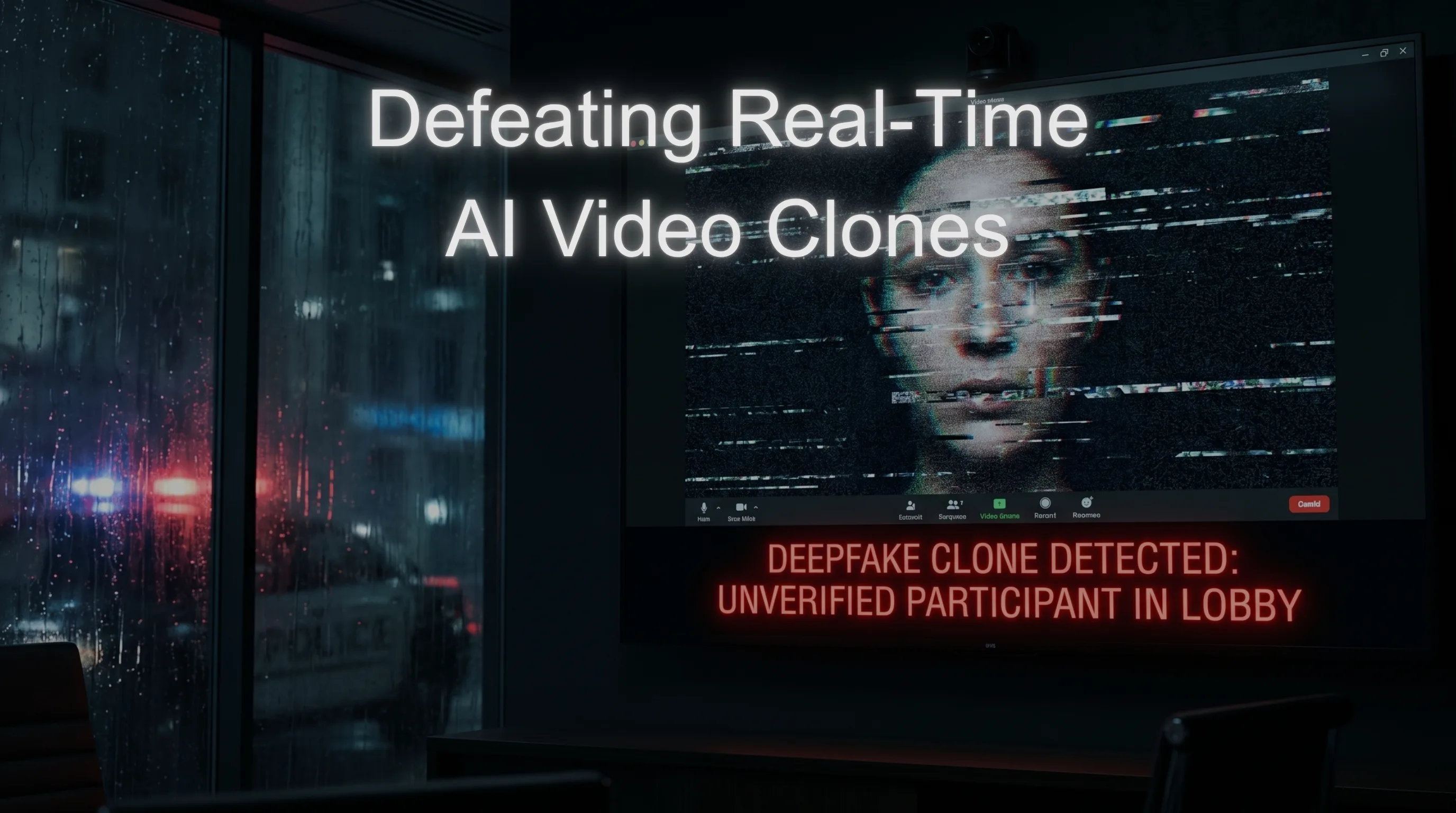
To identify real-time deepfakes, organizations must look for micro-stuttering, inconsistent lighting, and unnatural eye tracking. Implementing a challenge-response protocol: such as asking the subject to turn sideways: disrupts the generative model’s sync fabric. Always use out-of-band verification via a secondary, trusted channel before executing sensitive requests.
Monday morning, 8:05 AM. The digital air in the Microsoft Teams lobby feels heavy. Your CFO, or at least the high-definition rendering of him, joins the call three minutes early. He looks tired, the lighting in his home office is dim, and his voice carries the familiar rasp of someone who has been up all night closing a deal. He doesn’t waste time with pleasantries. There is a “liquidity emergency” with the Singapore acquisition, and if $25 million isn’t moved to a new escrow account within the hour, the deal collapses.
The psychological pressure is a physical weight — urgency-driven manipulation is the attacker’s primary tool. You see his face move. You see him blink. You hear him sigh with frustration as you ask for a secondary confirmation. This is the “Imposter in the Lobby.” It isn’t a pre-recorded video or a clever script: it is a real-time, generative specter. In 2026, the perimeter isn’t just your firewall: it is the very fabric of the human beings you see on your screen.
The Deep Dive: The Architecture of the Digital Mask
We have moved past the era of clunky, face-swapped memes. The technology that once required a server farm and weeks of rendering has been commoditized. We are now witnessing the industrialization of synthetic identity through the DaaS (Deepfake-as-a-Service) economy.
The DaaS Economy: Fraud as a Subscription
The barrier to entry for high-fidelity impersonation has evaporated. For a few hundred dollars a month, threat actors can subscribe to DaaS platforms that provide “live-link” capabilities. These platforms utilize pre-trained models of high-profile executives, politicians, and celebrities.
The attacker doesn’t need to be a data scientist. They simply sit in front of a webcam, and the software maps their facial movements, micro-expressions, and speech patterns onto the target’s digital twin in real time. These services often include AI voice cloning modules that analyze a few seconds of public audio: a keynote speech or a podcast: to create a voice skin that is indistinguishable from the original to the human ear.
The Sync Fabric: Where the Illusion Breaks
Despite the terrifying fidelity of these clones, they are governed by the laws of computation. Generating a 4K video stream at 60 frames per second with zero latency is an immense technical challenge. This is where the “Sync Fabric” comes into play. The AI must ingest the attacker’s movements, process them through a Generative Adversarial Network (GAN), and output the rendered frame.
This process introduces Latency Micro-stuttering. To the untrained eye, it looks like a “bad connection” or a “bandwidth spike.” In reality, it is the generative model struggling to keep up with the physical world. The “tells” are subtle but consistent:
- Lighting Inconsistency: The subject’s face might be lit by a cool blue monitor glow, but their background shows warm, afternoon sunlight. The AI often fails to harmonize the environmental lighting with the synthetic skin.
- The Profile Collapse: GANs are exceptionally good at “frontal” data. However, when a subject turns their head past a 45-degree angle, the model often loses its anchor points. The nose might “melt” into the cheek, or the ear might momentarily vanish.
- Digital Eye Tracking: Humans rarely stare directly into the camera lens for an entire conversation. Deepfakes often struggle with natural eye movement, resulting in a “dead-eyed” stare or an unnatural shimmering in the iris where the model is trying to render moisture and reflection.
Data Visualization: The Evolution of Impersonation
The shift from legacy vishing to real-time AI clones represents a quantum leap in social engineering effectiveness.
| Feature | Legacy Vishing | Real-Time AI Impersonation |
|---|---|---|
| Primary Vector | Voice only (Telephone) | Full Audio/Video (Video Calls) |
| Trust Factor | Low (Easily questioned) | High (Visual confirmation) |
| Preparation Time | Minutes (Script writing) | Hours (Model training/DaaS setup) |
| Detection Method | Vocal cues / Caller ID | Visual “tells” / Protocol challenges |
| Scalability | High (Call centers) | Moderate (Requires active operator) |
| Success Rate | ~2% - 5% | ~25% - 40% (Targeted attacks) |
Defeating the Imposter: Architectural Advice
To survive in this environment, we must stop trusting our eyes. Organizations must move toward a Zero-Trust Identity framework that applies as much to video calls as it does to server logins.
1. The Challenge-Response Protocol
This is your most effective immediate defense. If a high-stakes request is made, introduce a physical “computation challenge.” Ask the individual to turn their head slowly from side to side or to wave their hand in front of their face.
The movement forces the AI to re-render complex occlusions in real time. If you see the hand “blend” into the face or the cheekbone distort as they turn, you are looking at a clone. A real human being can pass these tests instantly: a generative model often breaks under the pressure of unpredictable physical motion.
2. Out-of-Band (OOB) Verification
Never execute a high-value transaction based on a single communication channel. If the CEO “appears” on a video call and asks for a wire transfer, the protocol must be to hang up and call them back on a known-good mobile number, or send a verification code via a secondary, encrypted platform like Signal or a hardware-protected Slack channel.
3. Forensic Lighting Analysis
Educate your team to look at the shadows. Deepfakes struggle with “soft shadows” around the neck and jawline. If the person on the screen looks like they have been “pasted” onto the background with perfectly sharp edges and inconsistent shadows, treat the call as hostile.
4. PhishPond.io: The Verify Before You Act Mandate
At phishpond.io, we believe the “human firewall” is a myth unless it is backed by architectural rigor. Our mission is to provide the tools for manual verification. In a world of synthetic video, your “gut feeling” is a vulnerability.
We encourage all practitioners to adopt the Verify Before You Act protocol. This means treating every video stream as a “data packet” that requires a secondary checksum. Use our link verification tools to investigate the origin of meeting invites. Many deepfake attacks begin with a compromised calendar invite or a link to a “custom” meeting platform designed to inject the malicious video stream.
Technical Glossary
- DaaS (Deepfake-as-a-Service): A cloud-based business model where attackers pay for access to high-fidelity AI impersonation tools and pre-trained models.
- Latency Micro-stuttering: Subtle, rhythmic pauses in a video stream caused by the computational overhead of generating synthetic frames in real time.
- Sync Fabric: The underlying alignment between the audio track, the visual mouth movements, and the facial expressions in a digital stream.
- Generative Adversarial Network (GAN): A class of machine learning frameworks where two neural networks (a generator and a discriminator) compete to create increasingly realistic synthetic data.
- Occlusion: The act of one object blocking another (e.g., a hand passing in front of a face). Rendering occlusions in real time is a common point of failure for deepfake models.
The Future of Digital Skepticism
The “Imposter in the Lobby” is not an anomaly: it is the new baseline. As generative AI continues to improve, the visual “tells” we rely on today will eventually vanish. We are rapidly approaching a reality where a video stream is as easy to spoof as an email “From” address.
The solution is not better video quality: it is better protocol. We must treat identity as a multi-factor equation. A face is just one factor. A voice is the second. But the third, and most important, is the Verified Path. If the path to that video call didn’t go through a trusted, multi-factor gateway, then the person on the screen is a ghost until proven otherwise.
The only thing more dangerous than a malicious link is a familiar face. Stay skeptical. Use your out-of-band channels. And before you move that $25 million, take a long, hard look at the shadows on the wall.
Sources & Further Reading
- CISA News and Advisories on Synthetic Media: cybersecurity advisories on synthetic media
- FBI IC3 2025 Deepfake Fraud Warning: 2025 IC3 annual report
- MITRE ATT&CK Social Engineering Techniques: T1566 phishing and social engineering techniques
- Microsoft Threat Intelligence Blog on Generative AI: Microsoft threat intelligence blog
- FIDO Alliance Whitepaper on Biometric Security: biometric security whitepaper
- NIST Guide to Digital Identity and AI: NIST SP 800-63-3 digital identity guidelines